

Choosing a career path once meant picking between a four-year degree or a handful of familiar trade programs. Today, a growing number of people are looking at the beauty and wellness industry as a legitimate, fast-moving alternative that offers real income potential without years of classroom debt. Medical aesthetics sits right at this intersection, blending healthcare know-how with cosmetic services in a way that is reshaping what vocational education even looks like. If you are weighing your options and wondering whether this field is worth the investment of time and money, understanding how these programs work is the first step.
Why Vocational Schools Are Adding Aesthetics Programs
Community colleges and private vocational schools have started adding medical aesthetics tracks because demand from students and employers has outpaced traditional cosmetology curricula. Med spas, dermatology offices, and wellness clinics are opening in nearly every mid-size city, and they need workers who understand both skincare and basic clinical procedures. Schools have responded by building shorter, more focused programs that get graduates into the workforce in months rather than years. This shift mirrors what happened decades ago with dental hygiene and radiology tech programs, which also grew out of a need for specialized mid-level healthcare workers.
The result is a new category of vocational education that does not fit neatly into old boxes like cosmetology or nursing. Students graduate with a skill set that overlaps both worlds, which makes them attractive hires for a wider range of employers.
- Faster completion times compared to nursing or physician assistant degrees
- Lower tuition costs than most four-year healthcare programs
- Curriculum built around real clinic workflows, not just theory
- Growing partnerships between schools and local med spas for clinical hours
Core Skills Taught in a Typical Program
A well-built program covers far more than makeup application or facials. Students typically learn skin physiology, sanitation and safety protocols, client consultation techniques, and how to recognize contraindications before performing any procedure. Many programs also include business basics, since a large share of graduates eventually work in commission-based or self-employed settings. The goal is to produce someone who can walk into a clinic and function safely on day one, not just someone with theoretical knowledge.
Hands-on practice is weighted heavily in these curricula because aesthetics work is physical and client-facing. Instructors usually require supervised practice hours on real or simulated clients before certification is awarded, which helps students build confidence before they are working unsupervised.
- Skin analysis and Fitzpatrick typing
- Chemical peels and microdermabrasion techniques
- Laser and light-based treatment fundamentals
- Sterilization and infection control standards
- Client intake and informed consent documentation
Injectable Services and Advanced Certification Options
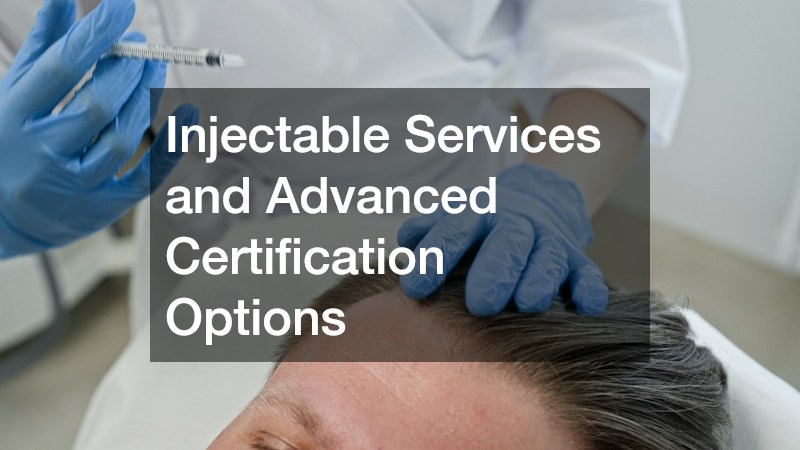
One of the biggest draws pulling students toward this field is the opportunity to eventually work with injectable treatments like neuromodulators and dermal fillers. These services command higher prices and higher demand, which makes them a natural next step for aesthetics professionals looking to grow their earning potential. Because of the medical risk involved, injectable training is typically offered as a separate, advanced certification rather than something folded into an entry-level cosmetology course. Programs that offer this kind of training usually require students to already hold a relevant license, such as an RN, LPN, PA, or in some states, an aesthetician credential with additional oversight.
Quality injectable training programs spend significant time on facial anatomy, needle technique, and complication management, since even minor errors can cause bruising, asymmetry, or more serious harm. Reputable courses include live model practice under the supervision of a licensed medical professional, not just video instruction. Prospective students should ask about instructor credentials, class size, and how many live injections they will actually perform before graduating.
- Facial anatomy and vascular danger zones
- Neuromodulator dosing and injection patterns
- Dermal filler selection for different facial areas
- Recognizing and managing vascular occlusion emergencies
- State-specific scope of practice rules for injectors
State Licensing Rules Vary Widely by Location
One of the more confusing parts of entering this field is that licensing requirements are not standardized nationally. Some states regulate aesthetics under cosmetology boards, others under medical boards, and a few have almost no specific licensing framework at all for certain procedures. This patchwork system means a program that qualifies you to work in one state might leave you undertrained or unlicensed in another.
Before enrolling anywhere, it is worth contacting your state’s licensing board directly rather than relying solely on a school’s marketing materials. Ask specifically which procedures require physician oversight, medical director supervision, or additional certification beyond the base program.
- Check whether your state requires a medical director for injectable services
- Confirm minimum hour requirements for licensure
- Ask if reciprocity exists if you plan to move states later
- Verify continuing education requirements to maintain your license
Comparing Program Costs and Realistic Job Outcomes
Tuition for medical aesthetics programs varies widely, ranging from a few thousand dollars for a basic certificate to well over fifteen thousand for comprehensive programs with advanced modules included. It helps to think of this as an investment decision rather than a simple purchase, weighing total cost against realistic starting pay in your local market. Entry-level positions in smaller markets may start modestly, while experienced practitioners in busy urban med spas can earn considerably more through commission and tips.
Job placement rates and employer partnerships are worth researching before you commit to any specific school. Programs with strong ties to local clinics tend to produce graduates who transition into paid work faster, since employers already trust the training pipeline.
- Ask schools for actual graduate placement statistics, not just estimates
- Compare tuition against average entry-level wages in your area
- Factor in the cost of continuing education for advanced certifications
- Look into whether financing or payment plans are available
Medical aesthetics training represents a genuinely new lane in vocational education, one that blends clinical rigor with the flexibility and creativity of beauty services. Before enrolling anywhere, take time to verify licensing requirements in your state, compare program costs against realistic earning potential, and ask schools hard questions about their outcomes. Doing that homework now will save you time, money, and frustration later, and put you on a clearer path toward a career that fits both your goals and your budget.